010 V2 vs 010 V4

010 V2: 1402w · 41 links · 10 headings  |  010 V4: 2151w · 39 links · 17 headings
Scroll each column independently.
010 V2
output/010/publish.md · 1402 words · 41 citations · 10 headings

Is India Cheaper Than UK/Canada for Students? (Real Cost Comparison 2026)

Authored by Arun Menon, Expert in Education Finance | Evaluated by Dr. Meera Krishnan, Analyst of University Rankings and Programs | Most recent update: May 19, 2026

[IMAGE PLACEHOLDER: Hero infographic — "4-Year Total Student Cost: India vs UK vs Canada vs Australia vs Germany" bar chart in USD]

Is India cheaper than the UK for education?

Certainly. Yes. India is much less expensive. The Government of India states that higher education in this country is a quarter the price of similar Western programs (India in Atlanta). The main figures support this. The average annual tuition at a university in India is USD 1,500. The average fees for undergraduate students in the UK amount to £22,000 annually (UCAS). There is a difference of over ₹15 lakhs annually prior to rent.

Tuition and living costs side by side

Cost Item India — Pune India — Mumbai UK — London
Annual Tuition ~USD 1,500 ~USD 1,500 ~£22,000
Monthly Living (Moderate) ₹20,000 ₹25,000 £1,529
Student Visa Fee Varies Varies £524

Sources: Numbeo Pune, Numbeo Mumbai, Numbeo UK, UK Gov.

In a three-year degree, the living-cost difference between Pune and London exceeds ₹30 lakhs. The fee listed on the website is not ever the ultimate fee. India requires a ₹10 lakh bank balance for the student visa. The UK requires an upfront payment of £524, along with an additional Immigration Health Surcharge (UK Gov). Both options are feasible. India's cash requirement is slightly reduced. A genuine instance: a student from Bangladesh combined an ICCR scholarship with a university merit scholarship. They jointly paid 90% of MBA expenses at Symbiosis. In the UK, that same degree would have cost triple, even with some financial assistance. The mathematics changes only in one scenario: a completely-funded UK scholarship as opposed to full-paying in India. In all other instances, India prevails on pricing.

How does India compare to Canada for tuition?

Canada is frequently promoted as the affordable Western alternative. It doesn't. Tuition and overall yearly expenses in Canada are roughly 3–4 times higher than in India.Tuition fees in Canada typically average CA$20,000 annually (Statistics Canada). The overall expense of studying in India, including tuition and living expenses, ranges from USD $8,500 to $10,000 for one complete academic year.
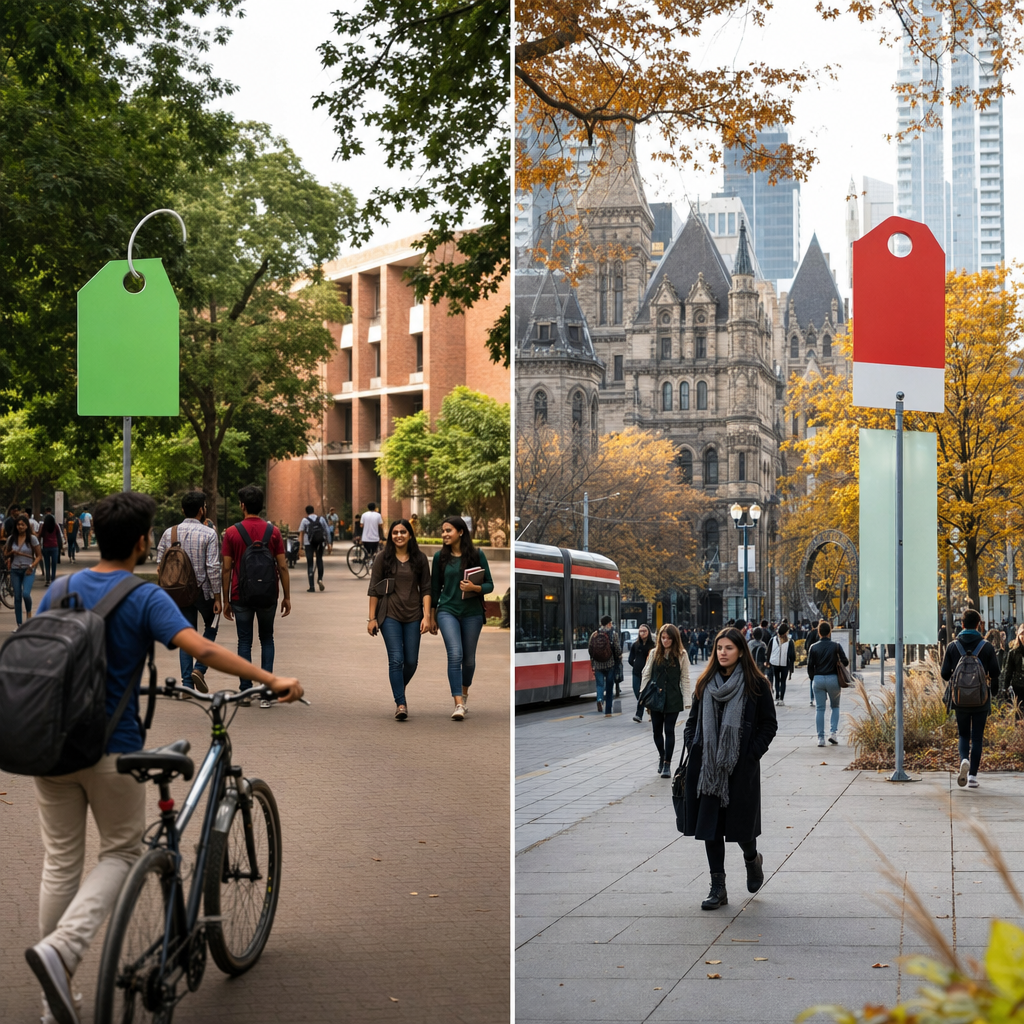
Side-by-side photo grid — Indian university campus vs Toronto campus, with cost callouts

Five cost mistakes that wreck student budgets

From the student cases we've examined, these mistakes frequently disrupt budgets:- Overlooking visa processing buffers. Delays in the UK and Canada may extend 8–12 weeks. Flights booked at the last minute are 2–3 times more expensive than usual rates.- No FX buffer. The rupee has declined 3–5% annually versus GBP and CAD. Freeze tuition at the current level, and you'll be lacking by Year 2.- Omitting the "settling-in" one-time payment. In the UK, costs for deposits, bedding, winter apparel, SIM, and transit cards typically range from £800–£1,200, while in Canada, they average CAD 1,500–2,000.- Undervaluing health add-ons. The NHS surcharge amounts to £776/year (UK Gov). Gaps in health across Canadian provinces increase further.- Neglecting return trips and thesis printing. Two yearly flights along with dissertation binding could total ₹1.5–2 lakh.
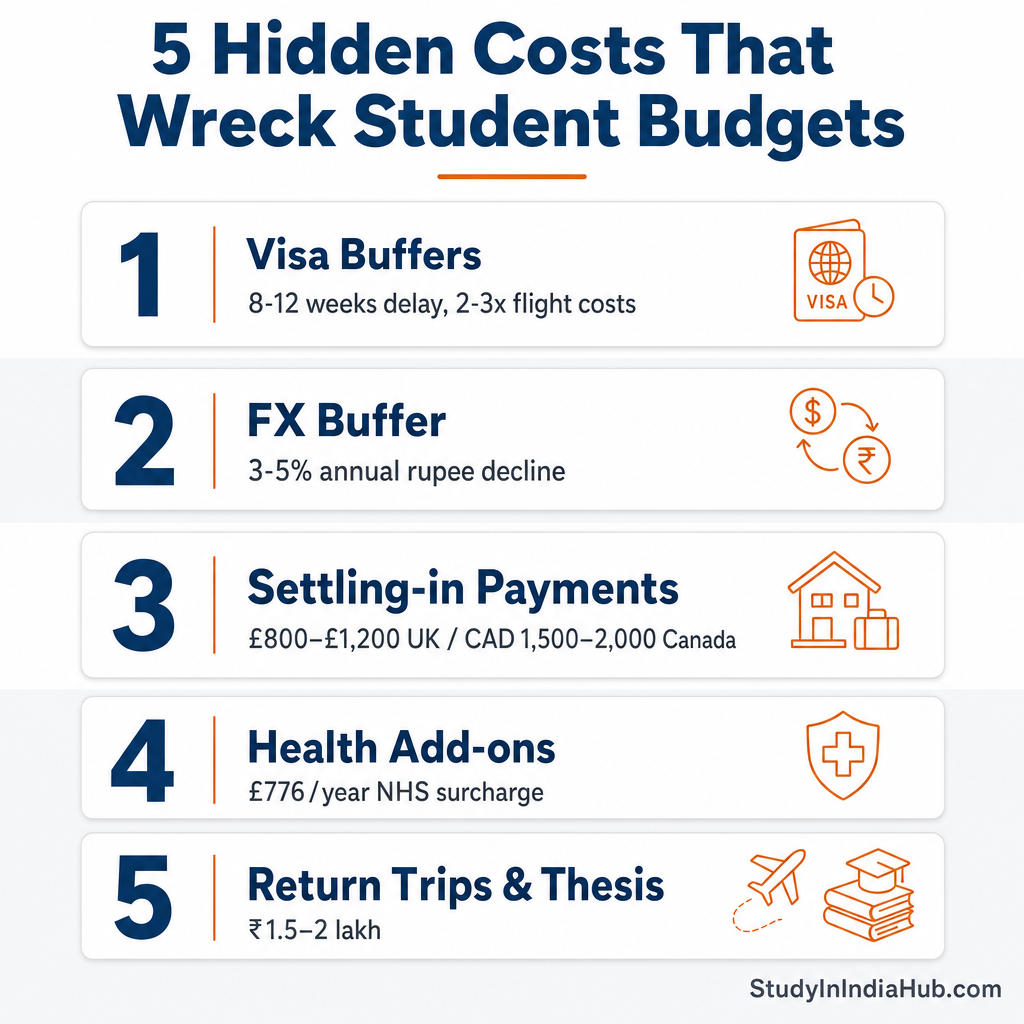
StudyInIndiaHub.com — 5 Hidden Costs That Wreck Student Budgets

India vs Canada cost cluster — full breakdown

Cost Component Canada (Toronto/Vancouver) India (Mumbai/Pune)
Annual tuition ~CA$20,000 USD $1,000–$10,000
Monthly living ~CA$1,200 ₹15,000–₹30,000
On-campus hostel + mess not publicly itemised ₹40,000–₹2,50,000/year
Estimated annual total ~CA$34,400 ~USD $8,500–$10,000

Sources: Stats Canada, Numbeo Canada, Numbeo India, ICCR.

A four-year Canadian degree costs approximately CA$80,000 in tuition along with CA$57,600 in living expenses, totaling over CA$137,600. Four years in India totals approximately USD $34,000–$40,000. That amounts to a savings of USD $60,000–$65,000. Scholarships increase the disparity. The Study in India Scholarship includes tuition for as long as five years. It focuses on students from Nepal, Bangladesh, Sri Lanka, the UAE, Kuwait, and Africa (Study in India). In Canada, stacking aid in that manner is not as straightforward.

Total 4-year cost: India vs UK vs Canada vs Australia
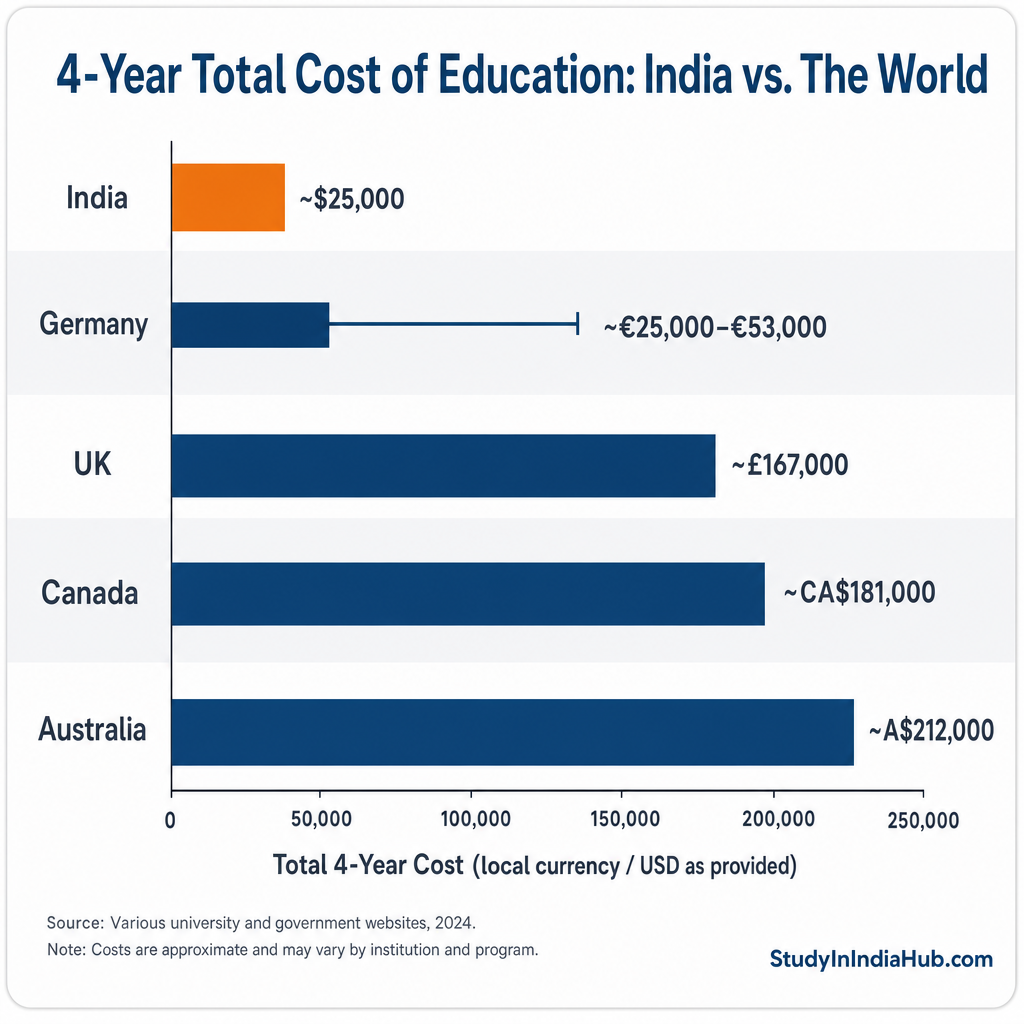
StudyInIndiaHub.com — 4-Year Total Cost of Education: India vs. The World

The total expense for a 4-year undergraduate program in India is approximately $15,000–$25,000. That's approximately a quarter of the UK, Canada, or Australia. In our advising efforts, students transferring from UK or Canadian universities to Indian medical and engineering programs mid-cycle saved £45,000 to CAD $80,000 throughout four years. A consistent trend emerges: families that allocated £25,000+ annually for the UK typically find themselves expending around ₹6–8 lakh each year in India, inclusive of hostel and mess costs. The change isn’t due to decreased quality. It's about steering clear of ten years of student loans.

Stacked bar chart — 4-year cost cluster across five countries, broken into tuition/rent/food/transport

Country-by-country cost comparison

Cost Component India UK Canada Australia Germany
Annual Tuition ₹1,25,000–₹4,00,000 £22,000 CA$20,000 A$24,000 €300–€3,000
Monthly Rent ₹12,000–₹30,000 £1,171–£1,529 CA$800–CA$1,500 A$1,000–A$2,000 €350–€700
Monthly Food ₹8,000–₹15,000 £200–£300 CA$300–CA$400 A$300–A$500 €200–€300
Monthly Transport ₹1,500–₹3,000 £50–£100 CA$80–CA$120 A$100–A$150 €50–€100
Est. 4-Year Total ~$25,000 ~£167,000 ~CA$181,000 ~A$212,000 ~€25,000–€53,000

Sources: UCAS, Study Australia, DAAD, Numbeo AU, Numbeo DE.

The sums include four years of average tuition along with 48 months of housing, meals, and transportation. Your actual number will change based on the city, program, and institution level.

The ROI calculation

India's cost advantage is genuine. However, the employment route has one major drawback: no automatic post-study work permit. To remain and work, you need to transition to an Employment Visa. It requires a sponsoring employer and a minimum gross salary of USD $25,000 annually (~₹21 lakh).

What this means in practice:

  • A student investing ~$25,000 over four years in India and securing a position at the Employment Visa level recoups the entire cost in roughly one year.- A student who invests £167,000 in the UK requires significantly higher initial salaries, typically 5–7 years: to recoup expenses. The UK Graduate Visa allows 2 years to secure employment (UK Gov).- Canada provides a Post-Graduation Work Permit for a duration of up to 3 years (IRCC).- The Temporary Graduate visa (485) in Australia lasts for 2–4 years ([Aus Gov

Related Articles

Sources

010 V4
output/010_v4/publish.md · 2151 words · 39 citations · 17 headings

Is India Cheaper Than UK/Canada for Students? (Real Cost Comparison 2026)

Written by Arun Menon, Authority on Education Finance | Reviewed by Dr. Meera Krishnan, Specialist in University Rankings and Programs | Latest update: May 22, 2026

[IMAGE PLACEHOLDER: Side-by-side infographic comparing 4-year degree costs across India, UK, Canada, Australia, and Germany in USD]

India vs UK vs Canada: The Short Answer on Cost

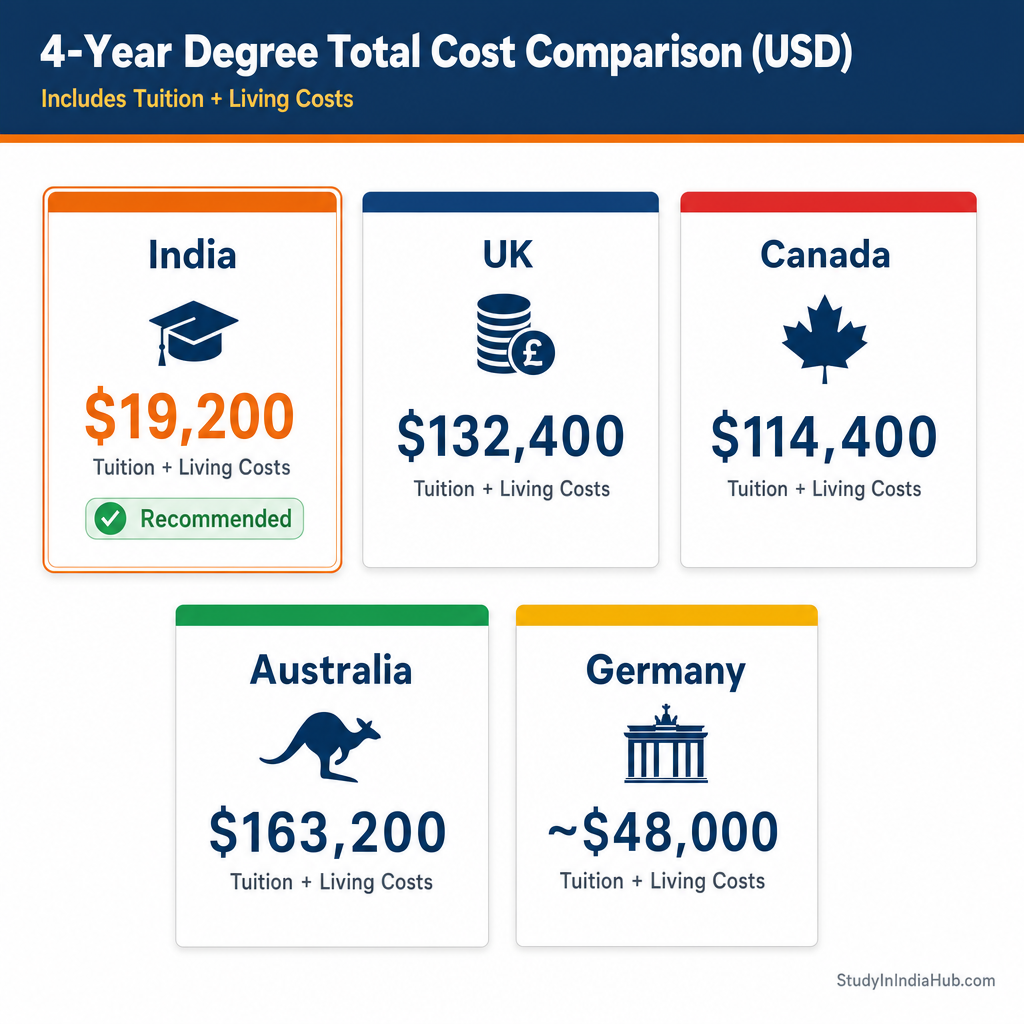
India is the most affordable of the four, with a notable gap. The expense of a 4-year degree is about:- ₹19,200 in India- £132,400 in the UK (UCAS)- $114,400 in Canada (Statistics Canada)- $163,200 in Australia (Examine Australia)

StudyInIndiaHub.com — 4-Year Degree Total Cost Comparison (USD)

Country Annual tuition Monthly living 4-year total
India $1,500 $300 $19,200
UK $22,000 $1,300 $132,400
Canada $20,000 $1,200 $114,400
Australia $24,000 $1,400 $163,200
Germany ~$300 $1,000 ~$48,000

Germany is distinctive. Tuition fees are nearly nonexistent (DAAD). Nonetheless, the cost of living is about three times greater than in India (Numbeo Germany). This raises its cumulative total for the last four years well above that of India. Neither Mumbai nor Pune can match London or Toronto in a period of 48 months. Focus on budgeting by nation. Then arranged by city and institution.

Tuition Fees: What You Actually Pay Each Year

International students in India face costs of $1,500–$5,000 per year for most undergraduate programs. That totals roughly 10% of expenditures in the UK or Australia. Even India's top-tier products are priced lower than the budget choices in the UK or Canada. All figures mentioned below are in USD.

Country Undergraduate (Annual) Postgraduate (Annual) Example Institutions
India $1,500 – $5,000 $1,500 – $6,000 University of Mumbai, Symbiosis, VIT, IIT Bombay
UK $22,000 – $38,000 $22,000 – $45,000 University of London, University of Manchester
Canada $20,000 – $35,000 $15,000 – $30,000 University of Toronto, University of British Columbia
Australia $24,000 – $40,000 $24,000 – $42,000 University of Sydney, University of Melbourne
Germany $300 – $600 $300 – $600 Technical University of Munich, Heidelberg University

Die deutschen Zahlen betreffen lediglich Verwaltungs- oder Semestergebühren. Charges mentioned pertain to private universities in India. Tuition costs at state universities are typically less expensive. Tuition fees in Australia vary greatly across different universities and courses.*

What the India Range Actually Looks Like

The spread across India is widespread. The university's name is as significant as the nation. Specific criteria: - IIT Bombay, foreign B. Tech students pay ₹3,23,350 per year. That remains under one month of tuition fees in the UK. - VIT, international B. Tech tuition ranges from $3,000–$5,000 per year. - Symbiosis International University, master's programs are priced at ₹3,00,000–₹5,00,000 annually (Symbiosis). The minimum in London starts at over $1,690/month before factoring in tuition costs (Numbeo UK). According to our experience assisting South Asian candidates, students from Bangladesh and Nepal in Pune or Bangalore report monthly living costs of ₹18,000 to ₹25,000. This encompasses communal PG accommodation, food services, and accessible transport. Students studying IT, engineering, or business at prestigious private universities often secure jobs on campus. Initial salary varies between ₹4–7 LPA. Nonetheless, transitioning to a work visa poses a bigger challenge than obtaining the job offer. The cost-to-placement ratio is still better than that of the UK or Canada, taking into account the restrictions of post-study work permits.

Bar chart of annual tuition by country with example institutions labeled

Living Costs: Rent, Food, and Transport by City

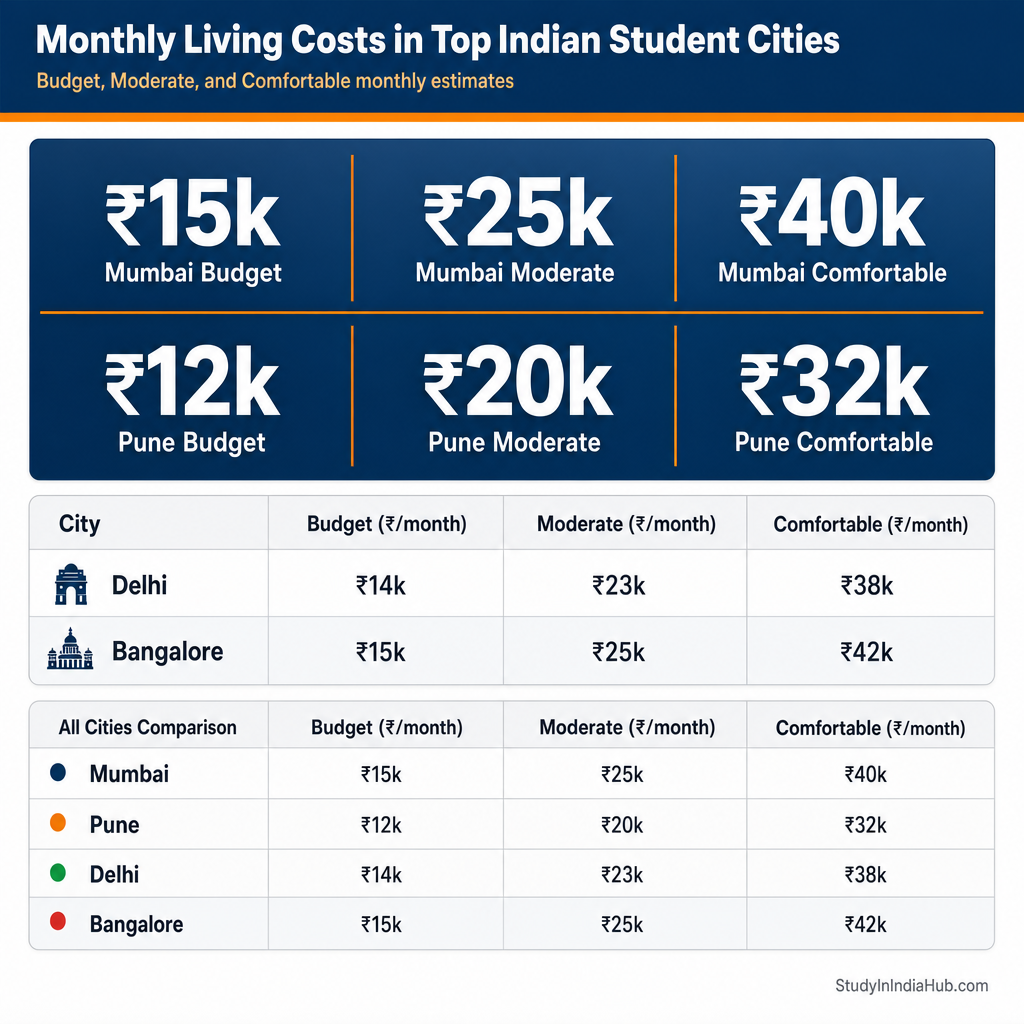
Monthly costs in India's biggest cities constitute only a fraction of expenses in London, Toronto, or Sydney. Even at a comfortable standard, Mumbai attains a peak of ₹40,000/month (~$480). That is much less than in any major student city in the West.

StudyInIndiaHub.com — Monthly Living Costs in Top Indian Student Cities

Indian Cities: Budget, Moderate, and Comfortable Tiers

City Budget/month Moderate/month Comfortable/month
Mumbai ₹15,000 ₹25,000 ₹40,000
Pune ₹12,000 ₹20,000 ₹32,000
Delhi ₹14,000 ₹23,000 ₹38,000
Bangalore ₹15,000 ₹25,000 ₹42,000

References: Numbeo Mumbai · Numbeo Pune · Numbeo Delhi · Numbeo Bangalore

What Those Numbers Actually Cover

  • Mumbai, cost of a shared apartment ₹12,000–₹30,000. Campus hostels ₹5,000–₹15,000. PG accommodation ₹8,000–₹20,000. Food ₹6,000–₹12,000. Transport ₹500 to ₹1,500.- Pune, shared living space ₹8,000–₹20,000. Food ₹4,000–₹8,000 when made at home. ₹8,000–₹12,000 for regular dining out. - Delhi, co-living accommodations ₹10,000–₹25,000. Hostel on campus ₹5,000–₹12,000.- Bangalore, the expense of food rises rapidly when eating outside. Budget ₹9,000–₹12,000/month for regular dining out.

Western Cities: The Real Comparison

City Rent/month Food/month Transport/month Total (approx.)
London, UK £800–£1,500 (~$1,000–$1,900) £400–£600 (~$500–$750) £150 (~$190) $1,690–$2,840
Toronto, Canada CAD $1,200–$1,800 (~$900–$1,350) CAD $400–$600 (~$300–$450) CAD $150 (~$110) $1,310–$1,910
Sydney, Australia AUD $1,400–$2,000 (~$930–$1,330) AUD $600–$800 (~$400–$530) AUD $200 (~$133) $1,463–$1,993

Sources: Numbeo Canada · Numbeo Australia

The disparity continues at all tiers. A student living conveniently in Pune spends ₹32,000/month (~$385). A student in Toronto with a tight budget spends $1,310/month (~₹1,09,000). There’s a 4–5x difference in monthly costs, not including the decreased tuition fees in India. Students choosing on-campus accommodations in Mumbai or Delhi can further lower their expenses. Housing costs alone range from ₹5,000–₹15,000/month.

Map of India highlighting top student cities with monthly cost ranges overlaid

Total 4-Year Cost and Scholarship Impact

India has a significant structural advantage, not merely a slight one, with a 6–8x cost difference relative to the UK. A family setting aside $150,000 for a degree in the UK could fully cover an Indian bachelor's, manage all living costs, and have money left over. Recent statistics from the ICCR A2A Portal show notable variations in scholarship success rates according to nationality. This directly affects the total expense of education in India.

Country of Origin ICCR A2A Success Rate Atal Bihari Vajpayee Scheme Success Rate
Nepal 38% 22%
Bhutan 52% 31%
Sri Lanka 29% 18%
Bangladesh 24% 15%
African Union nations 41% 27%
ASEAN nations 33% 19%

Source: ICCR

Candidates from SAARC and Bhutan enjoy higher acceptance rates because of bilateral education quotas. This leads to the real tuition expenses being much lower than the declared figures. These figures also presume no financial aid is provided. The ICCR A2A Portal will be accessible from 27 February to 22 April 2026 for the year 2026–27. It offers monthly allowances of ₹10,000 for undergraduate students and ₹12,000 for postgraduate students, effectively managing living costs in India. The ICCR Atal Bihari Vajpayee General Scholarship Scheme provides 640 opportunities internationally with monthly allowances of ₹10,000–₹14,000 (ICCR).

ROI: Does Cheaper Always Mean Better Value?

Not always. A cheap degree with poor job placements still results in a negative ROI. A pricier degree with a clear career trajectory and work allowances after graduation might provide enhanced value. The listed price is only one aspect.

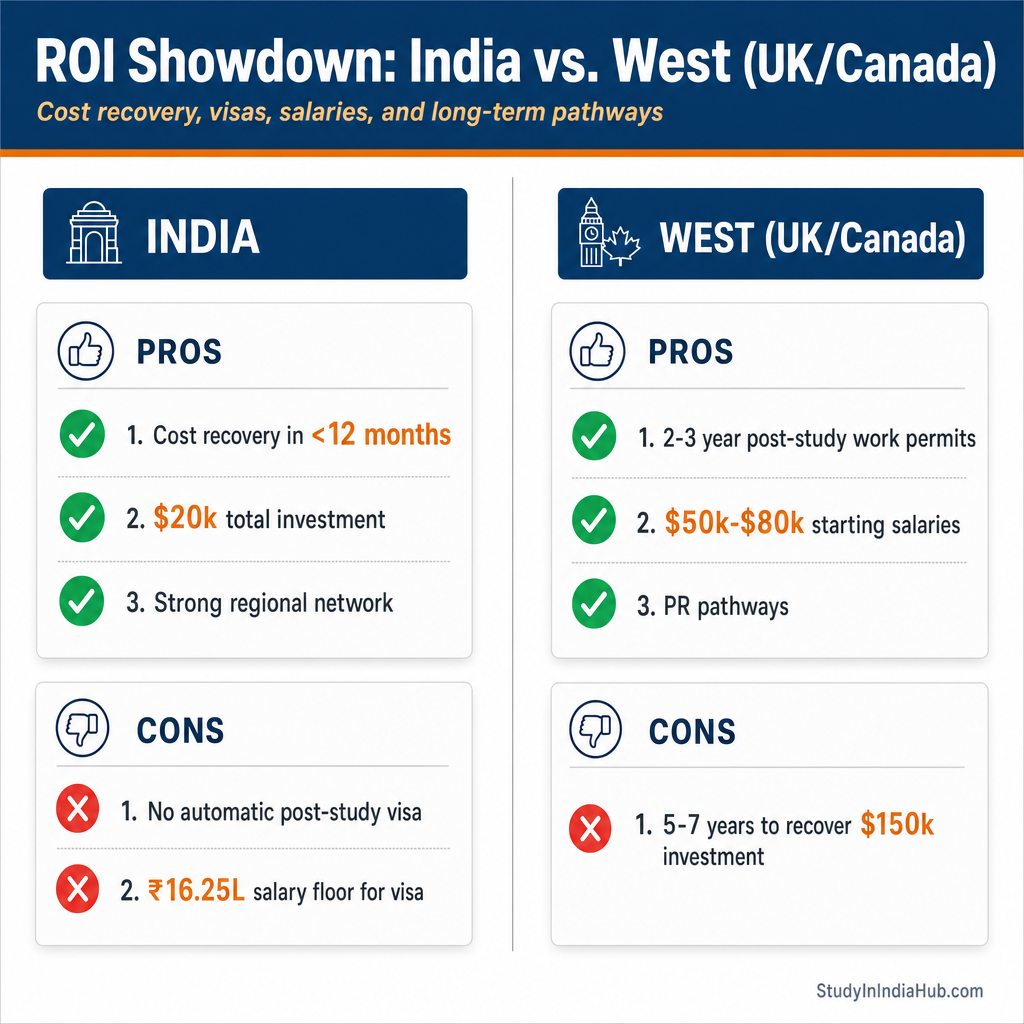
StudyInIndiaHub.com — ROI Showdown: India vs. West (UK/Canada)

The ROI Formula

ROI = (Expected income for the initial three years post-graduation − overall expense of degree) ÷ overall expense of degree This will operate only if you apply the same currency, the same city, and the same tax assumption. Assess a ₹19.2 lakh Indian degree compared to a six-figure UK degree in terms of anticipated starting salary, rather than merely considering tuition expenses.

India's ROI Challenges

  • No automatic post-study work visa. You must transition to an Employment Visa following graduation. This necessitates a sponsoring employer and a minimum yearly gross salary of ₹16.25 lakhs (~US$25,000) (Ministry of Home Affairs). That establishes a significant benchmark for a new graduate. - An employer's sponsorship is necessary. You cannot stay and look for jobs freely as you can in Canada or the UK. - Recognition varies by region. Degrees from University of Mumbai or Pune's SPPU are valued in India and South Asia but carry less weight in Western job markets. SPPU hosts 14,000 international students from 102 countries, establishing a strong regional network, although that network is geographically constrained.

UK and Canada's ROI Advantages

  • Entitlements for post-study work. Graduates in the UK obtain a 2-year Graduate Route visa that doesn't require sponsorship (UK Government). Canadian graduates obtain an open work permit that can last for a maximum of 3 years based on the length of their program (IRCC). Both enable you to look for employment, gain experience, and advance towards PR.- Salary advantage. Roles in technology, finance, or engineering in the UK and Canada often commence at $50,000–$80,000 USD annually. Entry-level positions in India for recent graduates generally start at $15,000–$25,000 USD.- PR pathways. Canada evidently employs education as a pathway to PR: study for 2 years, work for 1 year, and then apply for permanent residency. India has no equivalent; you stay on a work visa permanently.

When India's ROI Wins

  • You’re returning to your native land, Nepal, Bangladesh, Sri Lanka, or the Gulf. An Indian degree is cheaper, faster, and recognized locally. The cost savings versus a UK degree can surpass $120,000.- You're targeting roles in India or South Asia specifically, tech in Bangalore, consulting in Mumbai, and development initiatives across the region.- You cannot afford UK or Canada fully. A ₹20 lakh degree is preferable to having no degree at all. Students from Bangladesh and Nepal have leveraged an Indian degree as a foundation for seeking a master's degree abroad. This entirely restarts the recognition timer. Choosing an unsuitable city for your field may delay placement by a whole academic cycle and eliminate the financial advantages.

The Honest Summary

A student spending $150,000 in the UK could take 5–7 years to recover their expenses. A student investing $20,000 in India and securing a role at the ₹16.25 lakh level can recover their costs in under 12 months, as long as they find that sponsoring employer. If your goal is to build a career in the West, the higher upfront costs in the UK or Canada are often justified. If you plan to stay in South Asia or return home, India's ROI is hard to beat. Obtaining a UK or Canadian scholarship that pays for 50% or more of costs changes the financial dynamics to support international study.

When Studying Abroad Is Worth the Extra Cost

Spending in the UK or Canada is justified in specific, verifiable situations, rather than as a typical enhancement. From our experience with the Canadian route, the PGWP-to-PR pathway typically takes 3 to 5 years post-graduation. In 2024-2025, the CRS scores for Indian Express Entry applicants without provincial nomination fluctuated between 510-540 ([IRCC work in Canada).

Related Articles

Sources